Cedar Hill, Texas
Cedar Hill water damage restorationon one phone call
Water in a Cedar Hill house usually comes from one of three places: a failed pipe, a slab leak under the floor, or storm runoff coming off the hill. Call and you are connected with an independent local restoration contractor on that same call.
A referral service. The contractor you speak with is independent of this site.
- Burst pipes and appliance leaks
- Slab leaks under the foundation
- Creek and runoff flooding
- Sewage backups
- One callYour call goes straight to an independent contractor, who speaks with you on that call.
- Cedar Hill focusWritten for homes on the escarpment, around the creeks and near the lake.
- No formsNothing to fill in, and no details are collected for anyone to contact you later.
- Sources shownLocal and safety facts on this site carry numbered links you can check.
Key facts: Home
- Cedar Hill sits about 16 miles southwest of downtown Dallas on an Austin chalk uplift near 800 feet, with Joe Pool Lake along its western side.[1]
- The EPA advises drying wet areas and belongings within 24 to 48 hours to prevent mold growth.[2]
- On August 22, 2022, DFW Airport logged 9.19 inches of rain in 24 hours, and a Cedar Hill councilwoman reported a creek flood damaging homes along a street.[3][4]
- Standard US home policies generally cover burst pipes, but flood takes a separate policy. Check your own Texas policy.[5]
Start here
Which of these matches what you are seeing?
Pick the closest match. Each link explains what is usually behind it and what to do next.
Water spraying or running from a line
Close the main shutoff first, then read how pipe damage gets handled.
Read moreA warm spot or damp patch on a slab floor
Warm tile, a running meter and swelling baseboards often point below the foundation.
Read moreRainwater coming in at the doors
Muddy runoff is treated differently from a clean supply leak.
Read moreToilets or floor drains backing up
Keep people out of the area and stop using water in the house.
Read moreA brown ring on the ceiling
Roof, attic water heater and condensate lines are the usual suspects.
Read moreBoards rising at the edges
Cupped hardwood means moisture got underneath, and the source still matters.
Read more
Services
Water damage jobs in Cedar Hill, one at a time
Each page explains how the job is done, where a homeowner should stop, and what is particular to this city.

Burst Pipe Water Damage
Stopping the flow, then cleaning up after failed or frozen pipes.
Explore service
Flash Flood Cleanup
Cleaning and drying after storm runoff or creek water comes indoors.
Explore service
Sewage Backup Cleanup
Handling drain and sewer water safely, from the toilet to the main.
Explore service

Water Extraction and Drying
Pulling water out and drying floors and walls to a measured target.
Explore service
Safety comes before the shutoff
Stay out of standing water that could reach outlets, cords or the electrical panel. If you smell gas, leave the house and call from outside. Ready.gov warns that moving water only about six inches deep can take you off your feet, so never wade a low street or creek crossing.[6]
Once it is safe, close the main water valve for a plumbing leak. For a sewage backup, stop running water anywhere in the house. If your home is on the City of Cedar Hill system, the city water and sewer division lists its own numbers for main and sewer line problems.[7]
Why timing counts
Two days is the window that matters
The EPA's guidance is to dry wet areas and belongings within 24 to 48 hours to prevent mold growth, and to hold indoor relative humidity below 60 percent.[2] A summer afternoon in Dallas County makes that harder, because wet air indoors and a struggling air conditioner both slow evaporation.
Water also keeps moving after it looks gone. It wicks up drywall from the bottom edge, gets under baseboards and vinyl plank, and sits in carpet pad. That is why water extraction and drying relies on moisture meters and not on how a floor feels.
- Stop the source first
- Pull liquid water before it spreads
- Dry to a measured target
- Repair only after materials read dry

Local conditions
A hill city with clay, chalk and fast runoff
Cedar Hill is built on an Austin chalk uplift, and the western edge, including Lake Ridge, drops onto Eagle Ford shale near Joe Pool Lake.[1] The Eagle Ford is rich in clay and prone to erosion through slaking.[8] For a homeowner, that geology means slopes that shed water quickly and clay ground that is unforgiving where it stays wet.
Rain itself comes in bursts. Published 1991 to 2020 normals at Dallas Love Field show 39.33 inches a year, with October the wettest month.[9] A modelled Open-Meteo estimate for Cedar Hill reads higher, at about 49 inches a year long term and 39.2 inches for November 2025 to October 2026, with about 12 days a year of an inch or more. Model figures like these can run high for North Texas, so treat them as a rough guide only.

Before and after
From soaked floor to a room ready for repairs
This illustrative image shows the kind of change drying makes. It is not a photo of a specific Cedar Hill job.
 BeforeAfter
Typical situations
What the work looks like room by room
Illustrative images of common situations in North Texas homes.
- BeforeAfter

Under the kitchen sink
A failed supply line or dishwasher hose is a very common start.
- BeforeAfter

Garage water heater
Water often runs out under the door and into the shared wall.
- BeforeAfter

Second-floor bath
Upstairs overflows show up in the ceiling below.
- BeforeAfter

Bedroom carpet and pad
Saturated pad is usually pulled so the slab can dry.
- BeforeAfter

Flood cut in a hallway
Wet drywall is cut above the wet line when it cannot be saved.
- BeforeAfter

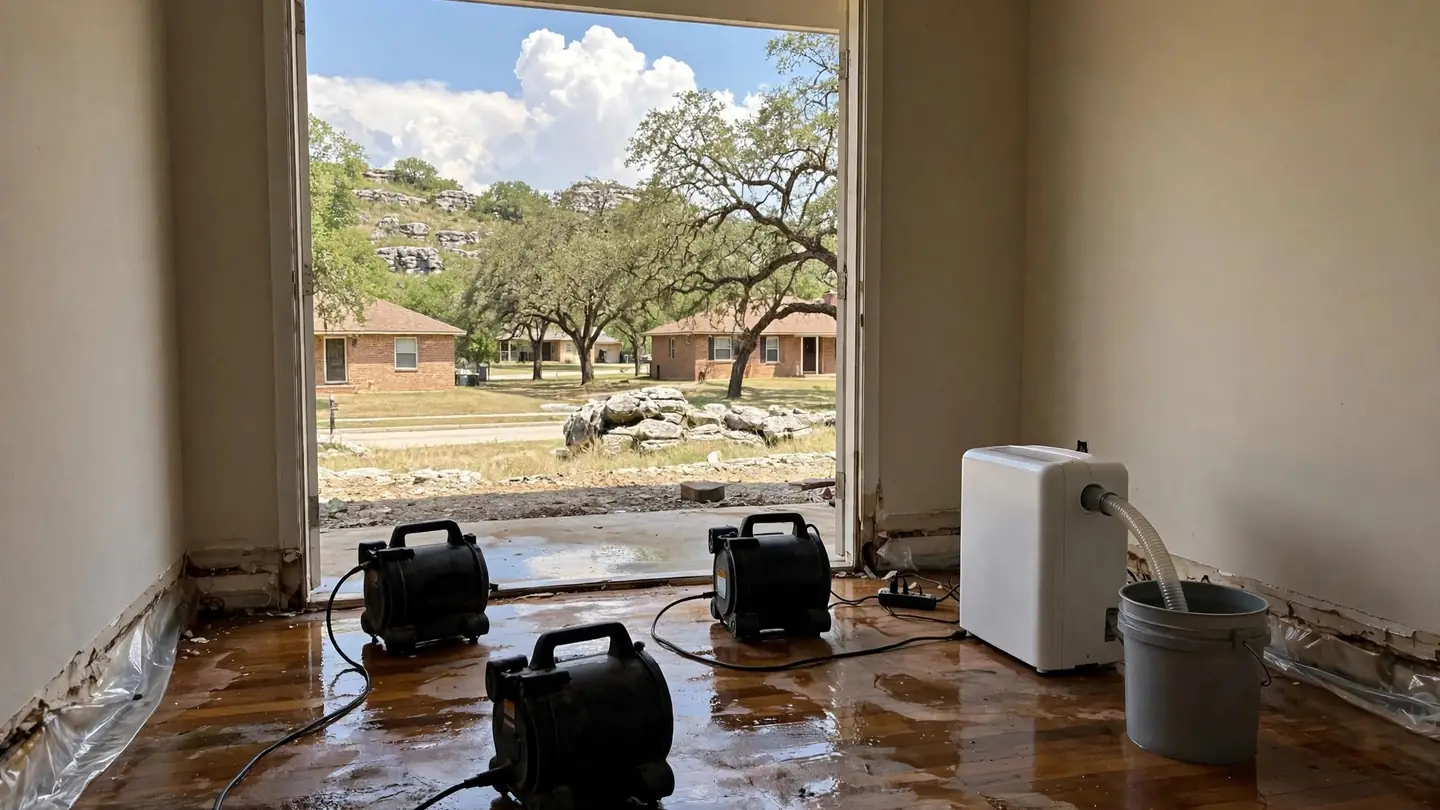
Runoff at a patio door
Muddy storm water calls for cleaning as well as drying.
Illustrative images. Every job depends on the property and the damage.
How it works
What happens when you call this number
- 1
You call
The phone system routes you to an independent restoration contractor who works in the Cedar Hill area.
- 2
You describe the water
Say where it is, what caused it, when it started and whether it has stopped.
- 3
The contractor explains next steps
You talk through what they would inspect and how the work usually runs.
- 4
You decide
Anything you arrange is agreed directly with that contractor on the call. There is nothing to submit.
Where
Cedar Hill neighborhoods with their own pages
Each page deals with what is different about that part of town: its ground, its housing and its water sources.
 Service area
 Service area
High Pointe
Named sections of different ages, so plumbing and materials differ street by street.
Learn more Service area
Historic Downtown
Homes from the 1880s and 1890s, with older materials and different rules of thumb.
Learn more Service area
Quick reference
Source, likely category and first move in a Cedar Hill house
| Where the water came from | How clean it usually is | First move |
|---|---|---|
| Supply pipe or washer hose | Clean at the start | Close the main valve |
| Water heater tank | Clean at the start | Close the cold inlet, turn off power or gas |
| Under the slab | Clean, but hidden | Close the main, watch the meter, call a plumber |
| AC condensate line | Clean to gray | Turn the system off, check the pan |
| Rain or creek runoff | Contaminated | Stay out until safe, photograph, keep clear of electricity |
| Toilet or sewer drain | Contaminated | Stop using water, keep people and pets away |
Categories follow the idea used in the IICRC S500 standard; a contractor confirms them on site.[10]
About this site
How this site works and who does the work
Water Damage Restoration Cedar Hill is a call-in referral service. Your call is connected to an independent local contractor who speaks with you on that call. This site does not perform restoration work, and its writers have not inspected your home.
Ask the contractor you reach about their own licences, insurance and availability, because those details belong to them and differ from one company to the next. Texas regulates mold work through the Texas Department of Licensing and Regulation, and Cedar Hill requires state-licensed trades such as plumbers to register with the city.[11][12]
Guides
Guides for the first days after water gets in
 Guide
Ceiling stain from an attic leak
Roof, attic water heater or AC drain: how to tell which.
Read the guide Guide
 Guide
Which insurance applies
Burst pipes, slow leaks, creek floods and sewer backups: which policy is which.
Read the guide Guide
 Guide
Texas mold rule
What the 25 contiguous square foot line means, and how the area gets counted.
Read the guide Guide
Questions
Common questions about water damage in Cedar Hill
What should I do first when water gets into my Cedar Hill home?
Make sure nobody is near wet outlets or moving water, then stop the source at the fixture or the main valve. Take photos before anything is moved, and then call so extraction and drying can start inside the first two days.
Does a house on a slab still have serious water damage?
Yes. A slab has no crawlspace to hold water, so water spreads across the floor and under walls instead. Baseboards, drywall, carpet pad and flooring all soak it up, and a leak under the concrete can stay hidden for a long time.
Does homeowners insurance pay for water damage in Texas?
Often for sudden events. Triple-I says standard home and renters policies cover burst pipes, while flood needs a separate policy and many policies do not cover sewer backups. Your own policy wording decides, so ask your agent.
Is this site the company that does the restoration?
No. This is a referral service. Your call connects you to an independent local contractor, and you make any arrangement directly with that contractor during the call.
Is every Cedar Hill address covered?
Coverage follows the contractors taking calls, and it can change. When you call, give your ZIP code or street and the contractor will tell you on the call whether they work at your address.
Coverage
Where this service takes calls
This site covers the city of Cedar Hill, in ZIP code 75104. Most of the city is in Dallas County, and a small southern section reaches into Ellis County, which can change which county records apply to your address.[1]
Pages on this site look closely at Lake Ridge, High Pointe, Bear Creek and Historic Downtown. Those are explanations of local conditions. They are not claims about past jobs in those neighborhoods.

Get connected
Talk to a Cedar Hill water damage contractor
Tell the contractor where the water is and how it got there. You are connected on that same call.
Sources and citations
- [1]Wikipedia: Cedar Hill, Texas
- [2]U.S. EPA: A brief guide to mold, moisture and your home
- [3]PBS NewsHour: Near-record rainfall floods Dallas-Fort Worth
- [4]KRLD/Audacy: Flood cleanup in North Texas, August 24, 2022
- [5]Triple-I: How to protect your home from water damage
- [6]Ready.gov: Floods
- [7]City of Cedar Hill: Water and Sewer
- [8]University of North Texas: Eagle Ford Shale field stop
- [9]Wikipedia: Dallas (climate normals and records)
- [10]IICRC: ANSI/IICRC S500 water damage restoration standard
- [11]TDLR: Mold Monitor bulletin, April 2025
- [12]City of Cedar Hill: Contractor Registration